
On Aug 1, a Mercedes-Benz electric sedan with batteries made by Chinese company Farasis Energy caught fire in the underground garage of an apartment in the South Korean city of Incheon.
The blaze took over eight hours to extinguish and reportedly damaged more than 100 cars. More than 20 people also suffered smoke inhalation and had to be hospitalised.
Just days later, a Kia EV6 burned out in a parking tower in South Chungcheong province, taking more than an hour to put out.
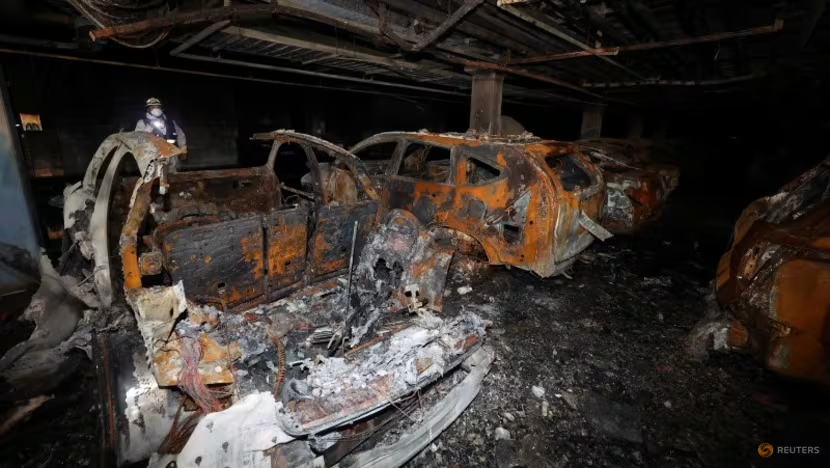
Last week, the National Forensic Service informed the police of the possibility that the fire was ignited by a damaged battery cell in the vehicle. Authorities indicated that a compromised battery cell is likely to have been the cause of the fire.
Due to this, many in the country are trying to tackle ways to deal with EV fire. Singapore’s Civil Defence Force (SCDF) and the Home Team Science & Technology Agency (HTX) had recently conducted an EV Fire test at the Home Team Tactical Centre to test SCDF’s fire fighting protocols for EV fires and measuring the effectiveness of firefighting instruments utilised in such scenarios.
During the test, an EV was intentionally lit to simulate a fire scenario, resulting in thermal runaway—a state in which the EV battery overheats uncontrolled. Within 10 minutes, the battery began to emit popping sounds, indicating thermal runaway. Approximately two minutes later, the EV was entirely enveloped in flames, with temperatures reaching 600 degrees Celsius.
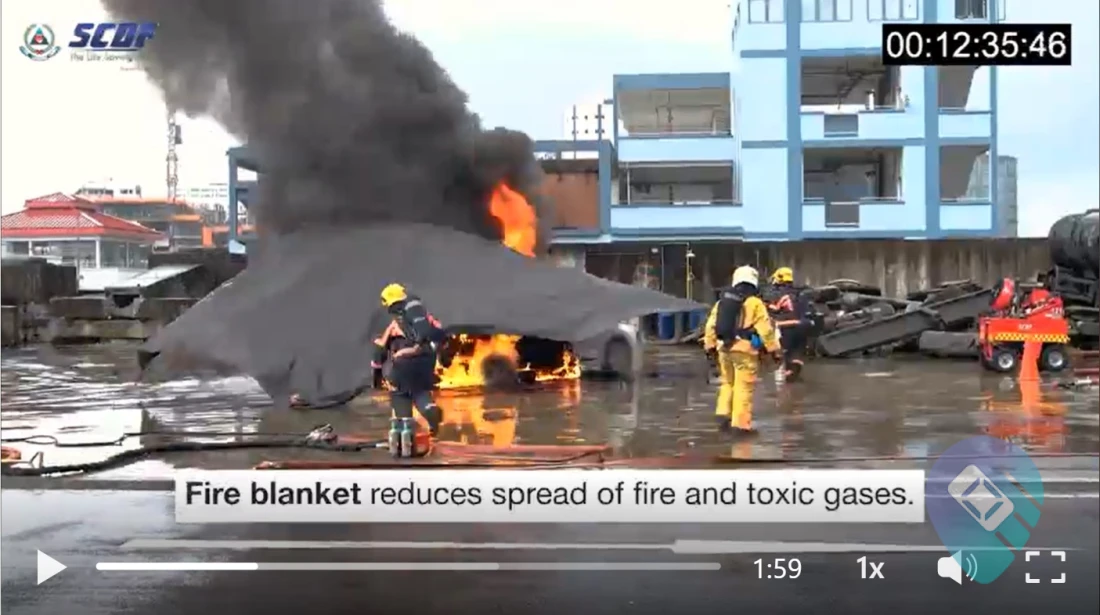
The initial approach by SCDF consisted of covering the EV with a fire blanket that could withstand temperatures up to 1,600°C. This blanket helped to contain the fire and prevent the spread of smoke, increasing visibility and allowing firemen to safely approach the vehicle. Water jets were then used to cool the EV, successfully lowering its temperature to roughly 300°C in three minutes.
Firefighters then used specialised equipment to puncture the EV’s battery casing beneath the vehicle, allowing them to pump water directly into the blazing battery. This method doused the fire in roughly two minutes, with the hottest point on the EV cooling to less than 150°C. Once the temperature fell below 100°C, the fire cover was removed, and the team undertook a dampening down operation to prevent a re-ignition.
The entire operation from the time of ignition to containment took roughly 45 minutes.
According to Singaporean authorities, this rigorous fire test validated the effectiveness of the SCDF’s firefighting techniques and equipment designed specifically for EV fires. Best of all all this details are well communicated to the Singaporean public.